So You Want to be A Freight Broker
If you’re interested in becoming a freight broker, one of the first things to understand is that there are different ways to build a career in the.



March 18, 2026 | Written by Patrick Brenda | Fuel Cost

Fuel is never a fixed number in trucking, and it is one of the few costs that can move after a rate is already quoted. Fuel surcharge is where LTL pricing breaks from what was quoted and turns into what actually gets billed. It is not a small add-on. It moves with the market, changes weekly, and can quietly shift the cost of a shipment after the quote is already out. That gap is where most of the confusion, and most of the margin risk, shows up.
Fuel surcharges in LTL are applied after the base rate and are tied directly to the U.S. Departmentof Energy diesel index. Carriers update these surcharges on a weekly schedule. When diesel prices increase, the surcharge increases. When diesel drops, the surcharge follows. These adjustments are standardized across a carrier’s network and are not negotiated at the shipment or lane level.
The disconnect comes from timing. Quotes are often generated using the current fuel percentage, but shipments do not always move under that same percentage. If the surcharge changes between quote and pickup, the final cost changes. Nothing operational has shifted, but the billed amount is different than what was originally quoted.
This dynamic is more pronounced in LTL because of how freight moves through the network. LTL shipments do not move directly from origin to destination. They move through a series of terminals, transfers, and linehaul legs. Each step consumes fuel. Compared to truckload, where a shipment typically moves on a single continuous route, LTL has more points of fuel exposure built into the movement.
That structure leaves little flexibility when fuel prices shift. Carriers adjust surcharge tables to reflect current diesel costs across the entire network. Those adjustments apply immediately to shipments moving under the updated schedule, regardless of when they were quoted.
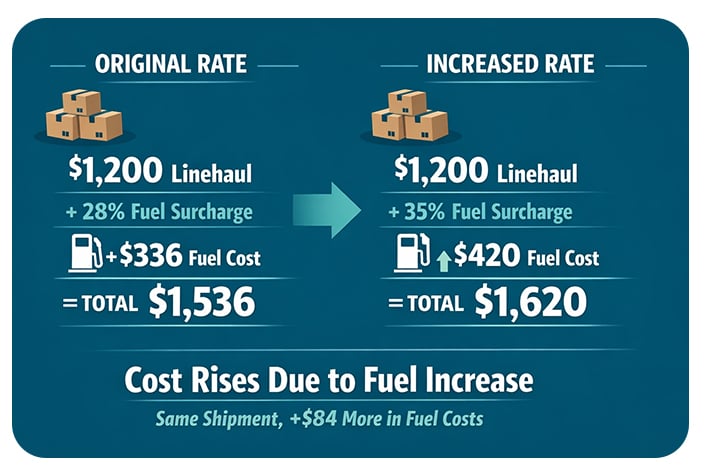
For agents and brokers, this creates margin exposure tied directly to timing. A shipment quoted at a $2,000 linehaul with a 25 percent fuel surcharge totals $2,500. If the actual surcharge at the time of movement is 33 percent, the cost becomes $2,660. That $160 difference is not the result of a pricing error. It is a result of fuel moving between quote and execution.
Shippers see the same issue through cost variance. Internal budgets are built on quoted numbers, but invoices reflect the fuel rate at the time of movement. When fuel shifts, landed costs change. Over time, this creates gaps between expected and actual transportation spend, especially in high-volume LTL environments.
Managing this requires treating fuel as a variable input at every stage. Shortening the time between quote and booking reduces exposure to surcharge changes. Clear communication around fuel being subject to weekly adjustment prevents downstream disputes. Carrier selection also matters. Networks with fewer transfers and more direct routing can reduce total fuel exposure across the shipment.
Fuel should also be tracked consistently. Weekly changes in the DOE diesel index directly impact LTL pricing. Small percentage increases can compound quickly across multiple shipments and should be accounted for in both quoting and planning.
Fuel surcharge is not a secondary line item in LTL. It is a primary cost driver that operates on its own timeline. Aligning quoting practices, expectations, and carrier strategy around that reality is the only way to reduce unexpected cost shifts after the shipment moves.

April 29, 2026
ShippersThe freight market has tightened over the past few years. Margins are thinner, service expectations are higher, and brokers are placing more value on.

March 25, 2026
Freight BrokerCoverage gaps rarely come down to rate alone. Carriers decide quickly which brokers they want to work with again. That decision is shaped by how the load.
March 12, 2026
Fuel CostFuel Prices and Transportation Costs Recent spikes in global oil prices have pushed diesel costs higher, putting renewed pressure on traditional.

March 10, 2026
TechnologyIntroduction Telematics in trucking is the new standard as carriers look to improve efficiency, safety, and regulatory compliance. These systems typically.

March 4, 2026
LTLThe less-than-truckload sector is a complex, precision-driven segment of freight transportation. It demands efficiency in scheduling, consistency in.
February 25, 2026
TechnologyIf you’re serious about expanding your customer base through cold calls, emails, and consistent outreach, you can’t rely on memory and sticky notes. The.
February 17, 2026
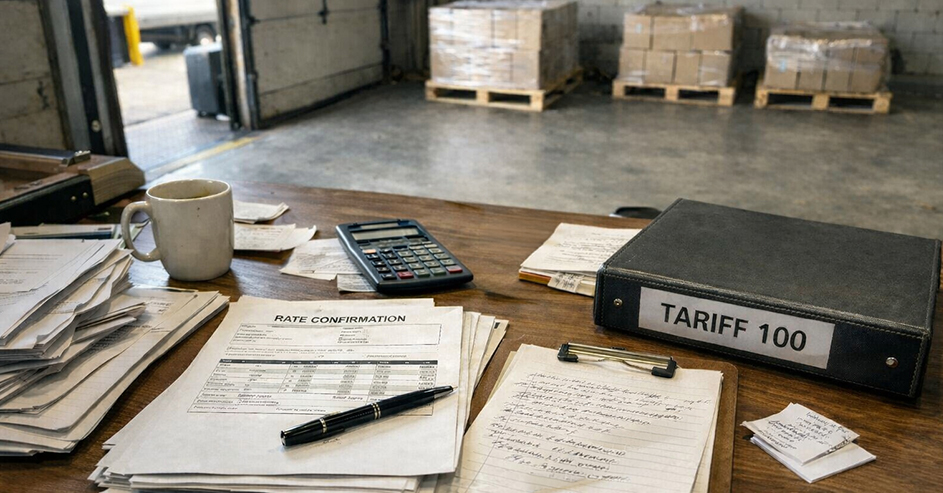
LTLTariff 100 governs how most LTL carriers apply rules, charges, and conditions to shipments. Brokers and agents interact with it every day, often without.

February 4, 2026
LTLOperational Problem Dimensioning errors are a consistent source of LTL cost overruns, rebills, disputes, and margin erosion. As carriers expand automated.

January 28, 2026
LTLAccessorial charges in LTL are often treated as an afterthought until they show up on an invoice. When that happens, the opportunity to control them is.

January 21, 2026
LTLFew issues create more downstream friction than a reweigh after pickup. What often begins as a small weight discrepancy can quickly turn into higher.

January 14, 2026
claimsThe Strategic Importance of A Well-Managed Claims Process At Logistics Dynamics, we understand that freight damage or loss impacts far more than inventory.

January 7, 2026
LTLLess-than-truckload (LTL) shipping is a practical solution for businesses that move freight without needing an entire trailer. Instead of paying for.
December 23, 2025
Logistics IndustryEvery December, the industry takes part in the most unforgiving logistics operation of the year. There’s no flexibility, no partial successes, and no.

December 10, 2025
LTLFor many businesses, not every shipment fills a trailer, and not every order justifies the cost of moving a full truckload. That gap is exactly where Less.