Every December, the industry takes part in the most unforgiving logistics operation of the year. There’s no flexibility, no partial successes, and no acceptable delays. Miss the deadline and Christmas morning is a failure.Christmas in America feels effortless when it works. Gifts appear under trees, letters get answered, and traditions carry on seamlessly. But that smooth experience is the result of the logistics industry operating under insane pressure.
This is how it began.
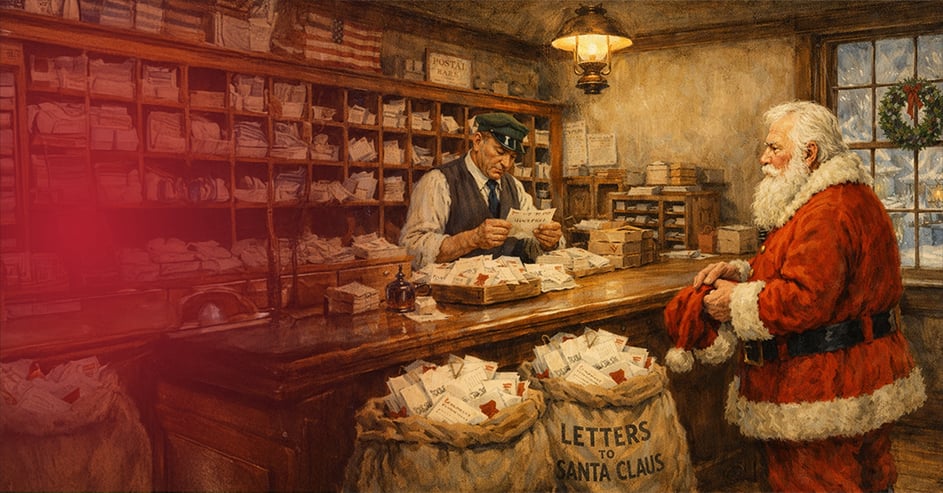
In 1912, the United States Postal Service made a policy decision that would unintentionally create one of the most complex seasonal logistics challenges the country had seen up to that point. For the first time, the Post Office allowed letters addressed to Santa Claus to be delivered instead of discarded.
The result was immediate. Letters poured in from kids across the country, many without return addresses, most handwritten by kids trying to get their lists to Santa. What followed wasn’t a warm and fuzzy feeling for the people delivering mail. It was an operational problem.
Post offices were suddenly responsible for handling massive volumes of nonstandard mail, all with a hard deadline. There were no “real” destinations, no routing rules, and no formal fulfillment process. Each letter represented a promise made by the post office, and every promise had the same due date.
Local postmasters began improvising. Letters were sorted by region. Volunteers were recruited. Community organizations and businesses stepped in to help fulfill requests. Without calling it logistics, they were building intake systems, classification rules, fulfillment networks, and last-mile delivery plans.
By 1914, the process became formalized as Operation Santa Claus.
Operation Santa introduced logistics realities that are still familiar today. There were strict cutoff dates. Items had to be sourced, packaged, and delivered locally to meet timing constraints. Weather delays were constant. Miss the deadline, and the entire effort failed, not partially, but completely.
The success metric wasn’t efficiency or cost savings. It was joy to America kids on Christmas morning.
Over time, Operation Santa helped shape how Americans experienced the holiday. It trained postal workers to handle seasonal volume spikes. It normalized surge planning. It reinforced the idea that nationwide delivery could be coordinated, even under extreme constraints.
This mattered far beyond Santa letters. As catalogs, retail shipping, and parcel delivery expanded through the mid‑20th century, the public expectation was already set. Christmas gifts were supposed to arrive on time. There was no room for excuses. The system either worked, or it didn’t.
Santa became the symbol, but logistics was the engine for the holiday.
Santa was a routing placeholder, a symbolic consignee representing millions of real delivery commitments. Once America proved it could keep that promise, year after year, the bar was permanently raised for every logistics operation that followed.
Modern Christmas logistics is more advanced, more automated, and far more visible. But the pressure hasn’t changed. The window is still fixed. The expectations are still concrete. Failure is still measured in disappointment, not delays.
Long before anyone called it logistics, America was already learning how to deliver Christmas on time.